The coffee maker gurgles away for a few minutes every morning, and most of us just stand there waiting. Those few minutes are also enough time for a short, simple set of exercises, done right in your kitchen chair.
You do not need special clothes, a mat, or any equipment. Just a sturdy chair and a little space around it.
Set Up Your Chair First
Pick a chair with no wheels, one that will not roll or slide when you push against it. A kitchen chair or dining chair usually works better than an office chair.
Place the chair with its back against a wall if possible, so it cannot tip backward while you are using it. Sit toward the front of the seat with both feet flat on the floor.
Seated Marching
Sit up tall and lift one knee up toward your chest, then lower it and lift the other. Keep going, alternating legs, like a slow march while seated.
Start with 10 to 15 lifts on each side. This warms up your hips and gets your heart rate up slightly, all without leaving the chair.
Leg Straightening
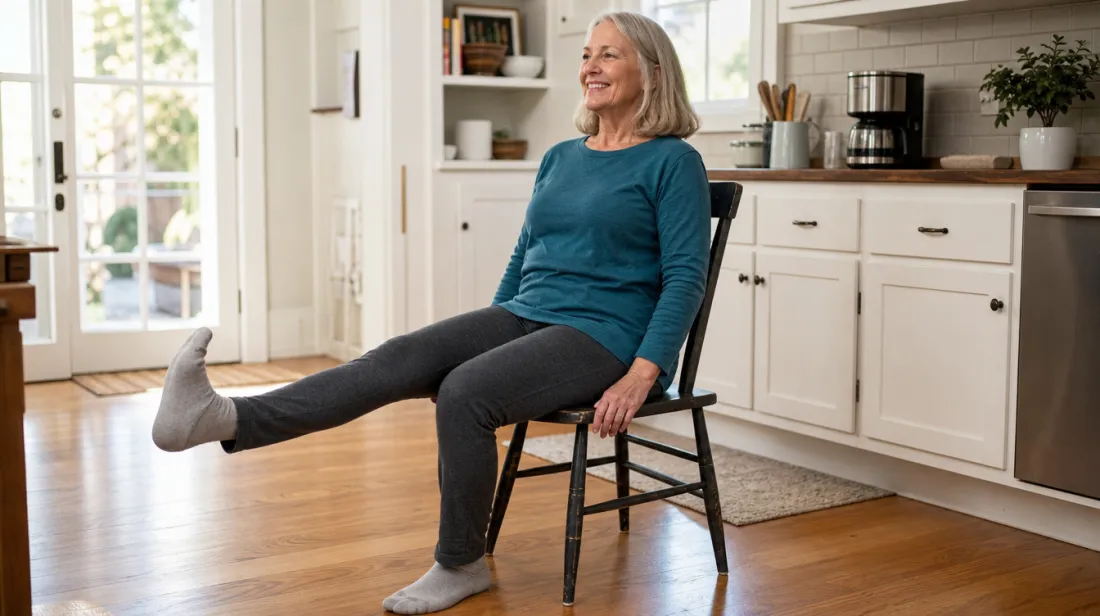
Sitting tall, straighten one leg out in front of you until your knee is fully extended, then lower it back down with control. This move, sometimes called a knee extension, works the muscles across the front of your thigh.
Do a few repetitions on one leg, then switch. These muscles help support your knees, which matters for everything from stairs to standing up from a chair.
Ankle Circles and Arm Raises
While seated, lift one foot slightly off the floor and slowly circle your ankle a few times in one direction, then the other. Switch feet and repeat. This helps with circulation and ankle flexibility, especially useful first thing in the morning.
For your arms, raise both arms out to the sides or straight up overhead, then lower them slowly. A few slow repetitions loosens up your shoulders while you wait for that last cup to finish brewing.
Finish With a Sit to Stand
Scoot to the front of the chair, plant your feet, and stand up using your legs rather than pushing off with your hands if you can manage it. Sit back down slowly and repeat.
This single move, standing up and sitting back down with control, is one of the most useful exercises there is for staying independent. It uses many of the same muscles you rely on to get out of a car or off the couch.
- Start with just a few repetitions of each exercise, not a long session
- Add a repetition or two each week rather than jumping to a full routine right away
- Move slowly and with control rather than quickly
When to Stop, and Who Should Check First
Stop right away if you feel pain, dizziness, or shortness of breath during any of these movements. Those are your body's signal to rest, not to push through.
If you are new to exercise, or you have a heart condition, talk with your doctor before starting any new routine, even one this gentle. They can tell you if anything here needs adjusting for your particular situation.
A Habit Small Enough to Keep
The whole point of this routine is that it takes no extra time out of your day. You are not carving fifteen minutes out of your morning, you are simply using minutes that were already going to pass while the coffee brewed.
Small routines like this one tend to stick around precisely because they are easy to start and hard to forget. A few weeks of this, most mornings, adds up to real movement over the course of a month.