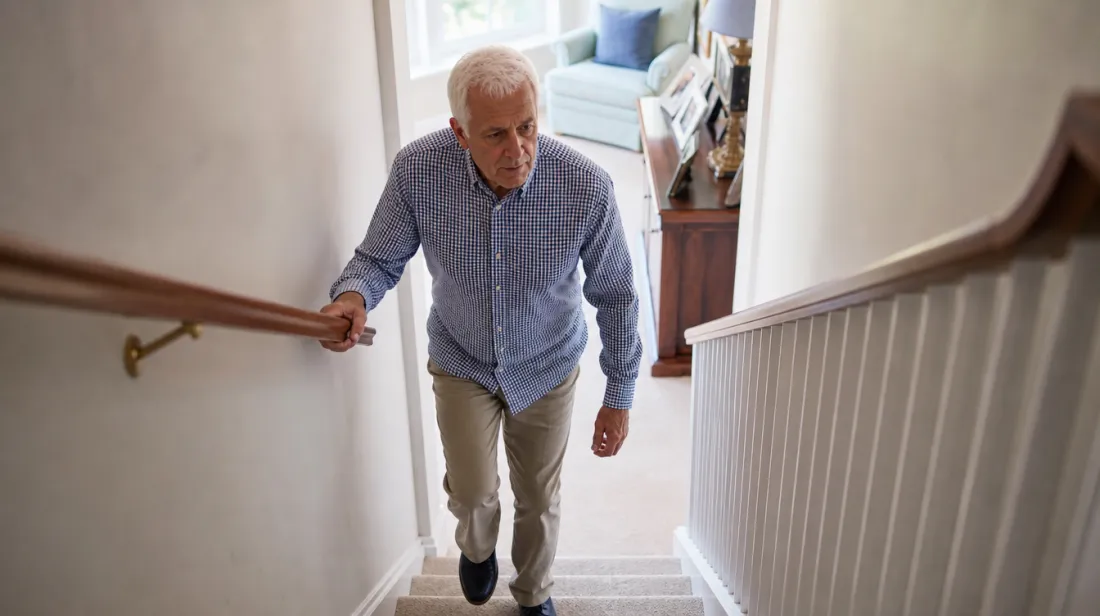
You can walk across the living room without a second thought, but the staircase is a different story. A few steps in, your knees start to ache, and by the top you are gripping the railing a little tighter than you used to.
This is one of the most common complaints people bring up as they get older, and there is a straightforward reason behind it.
Why Stairs Are Harder on the Knees
Climbing or descending stairs puts significantly more load on your knee joint than walking on flat ground does. Every step up or down asks your knee to bear more of your body weight, at more of an angle, than a level surface ever does.
That is simply how stairs work, for every knee, at every age. It is not a sign that something unusual is happening to you specifically.
Common Reasons the Ache Shows Up
A few things tend to make that extra load feel worse. Weak thigh muscles are one of the biggest factors, since those muscles are what control and cushion your knee on every step.
Stiffness in the joint, especially first thing in the morning or after sitting a while, is another common cause. Arthritis in the knee is also a frequent reason stairs feel harder than they used to, since the cartilage that normally cushions the joint has worn down.
Use the Handrail, and a Trick From Physical Therapists
Always use the handrail on stairs. It is not a sign of weakness, it is one of the simplest ways to protect your knees and your balance at the same time.
Physical therapists teach a simple rule for which leg leads: up with the good, down with the bad. That means step up first with your stronger leg, and step down first with your weaker or more painful leg. This spreads the hardest part of the work to the leg better able to handle it.
Gentle Strengthening That Can Help
Building strength in the muscles around your knee, especially the thigh, can make a real difference over time. Two simple exercises are a good place to start.
- Straight leg raises: lying down or seated, straighten one leg and lift it a few inches, hold briefly, then lower it slowly. This works the thigh muscle without bending the knee at all.
- Sit to stand: from a sturdy chair, stand up using your legs and sit back down slowly, with control. This builds the same muscles you use going up stairs.
Start with a small number of repetitions and add more only as it feels comfortable. Consistency over weeks matters more than pushing hard on any single day.
When Knee Pain Needs a Doctor's Look
Some aching on the stairs is common and often improves with the steps above. But swelling in the knee, a joint that locks or catches, a knee that gives way underneath you, or sudden severe pain are all reasons to see a doctor rather than waiting it out.
A doctor can look at what is actually happening inside the joint and figure out whether it needs more than rest and gentle strengthening.
Stairs Do Not Have to Stay Dreaded
Most knee aches on stairs improve, at least somewhat, with stronger thigh muscles and smarter habits like leading with the right leg. It rarely happens overnight, but a few weeks of gentle strengthening tends to show up as an easier climb.
Pay attention to which stairs bother you most and when. That pattern, along with the exercises here, gives you something concrete to work with instead of just bracing for the ache every time.