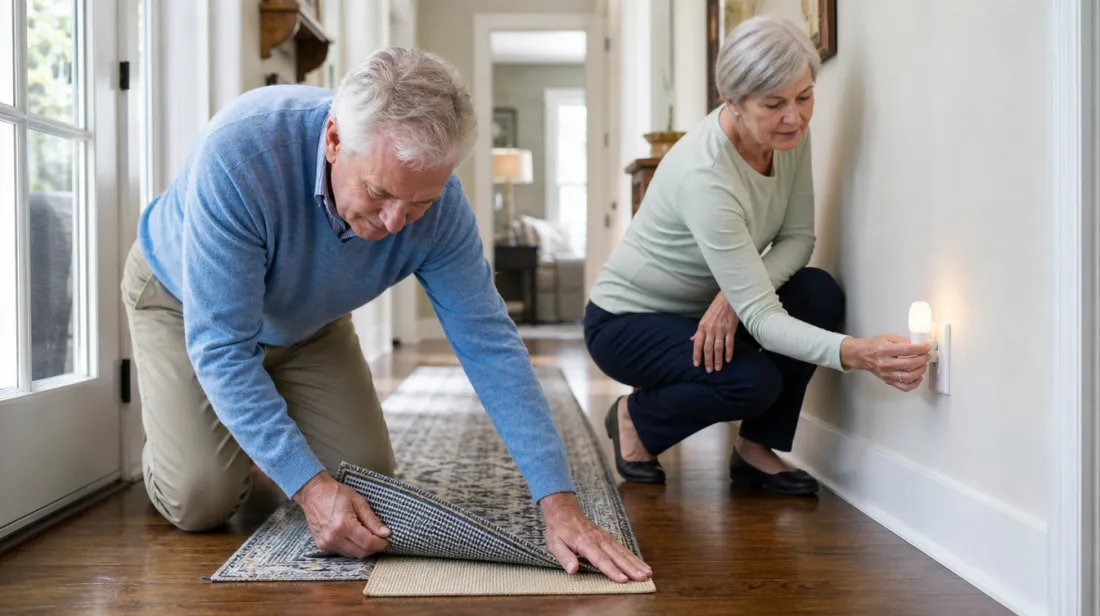
Falls are common, and they are not a sign that something is wrong with you personally. The CDC says about 1 in 4 adults 65 and older falls each year. Most of those falls happen in ordinary places, like a bedroom, a bathroom, or a set of stairs used every single day.
The upside is that a lot of falls are preventable with small, specific fixes. This is not about turning your home into something unfamiliar. It is about walking through each room with fresh eyes and fixing the handful of things that actually cause trouble.
Go room by room. You do not need to do it all in one afternoon.
Living Room and Hallways
Clear walkways are the simplest fix and the easiest to overlook, because clutter builds up gradually. Walk the path you take most often, from your favorite chair to the kitchen, and remove anything sitting in that line.
Throw rugs are a common cause of trips. Remove them where you can, and where you cannot, secure them with non-slip backing or tape so the edges cannot curl up underfoot.
Keep cords for lamps and electronics run along the wall, not across a path you walk. Furniture with sharp corners is worth rearranging if it sits somewhere you brush past often.
Bedroom to Bathroom
The walk from bed to bathroom in the middle of the night is one of the more common places a fall happens, mostly because it happens in the dark, half asleep. A night light along that path, or a motion sensor light that turns on by itself, removes a lot of that risk.
Keep a clear path between the bed and the door. Anything on the floor along that route, a bag, a pair of shoes, a low stool, is worth moving somewhere else entirely.
Bathroom
Grab bars near the toilet and inside the shower or tub give you something solid to hold onto on a wet, slippery surface. Non-slip mats inside the tub and on the bathroom floor cut down on one of the most common causes of a bathroom fall.
A bathroom rug without a non-slip backing can slide out from under you the moment you step onto it wet. If yours does not have one, it is worth replacing or securing.
Stairs
Handrails on both sides of the stairs, not just one, give you something to hold onto no matter which way you are facing. Make sure every step is clear of shoes, boxes, or anything else waiting to be carried up or down later.
Light switches at both the top and bottom of the stairs mean you are never walking into the dark to find one. If a switch is only at one end, that is worth having fixed.
Kitchen
Keep the items you use most often on shelves you can reach without stretching or climbing. A cabinet that requires standing on a chair to reach the top shelf is a fall waiting to happen.
If you do need to reach something high, use a sturdy step stool with a handle, never a chair or a stack of books. A proper step stool is built to hold your weight safely in a way ordinary furniture is not.
Two More Things Worth Checking
Some of the biggest risk factors for falling are not about the house at all. Ask your doctor or pharmacist whether any of your medicines can cause dizziness or drowsiness, since several common ones do.
Getting your vision checked regularly, and keeping up some form of balance and strength exercise, are two of the most effective things you can do to lower your fall risk overall.
When a Fall Needs Medical Attention
If a fall involves a hit to the head, call a doctor, especially if you take blood thinners. Head injuries can be more serious than they first appear, and blood thinners raise that risk further. When in doubt after any fall, it is always worth getting checked.