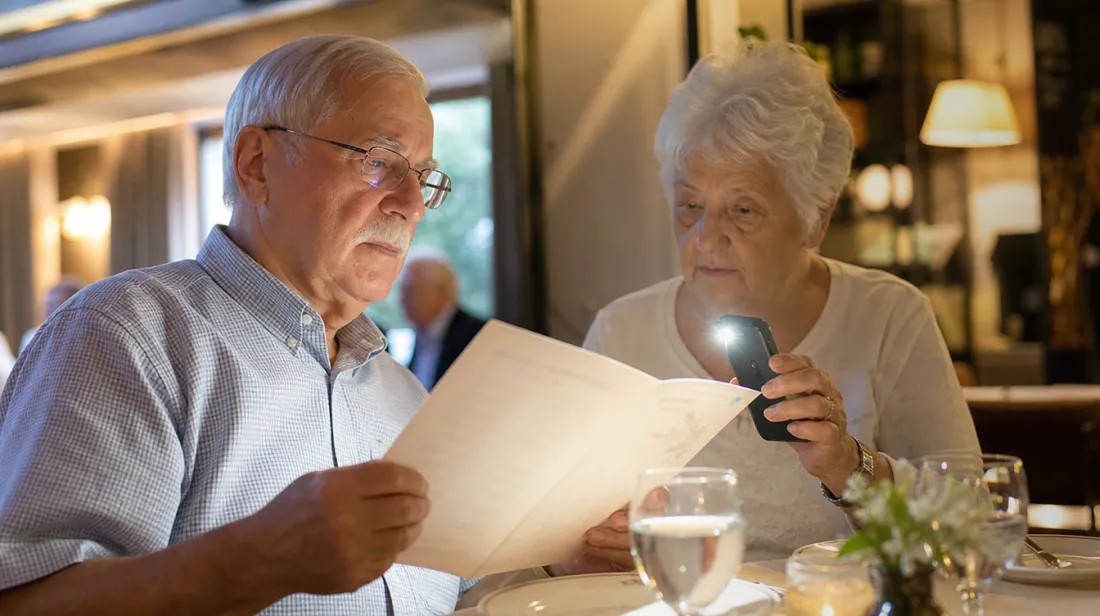
The lights go down, the menu comes out, and suddenly the print looks smaller than it did an hour ago. This is not just you having a bad day.
Two things are working against you at once: your eyes need more light to focus up close as you get older, and the room just gave you less of it.
Your Eyes Need More Light Than They Used To
As you move through your 40s and beyond, the lens inside your eye stiffens and loses some of its ability to bend and focus on close objects. This is called presbyopia, and it happens to nearly everyone eventually, not just people with existing eye problems.
At the same time, older eyes need more light to see clearly than younger eyes do. Put those two things together at a dim restaurant table, and a menu that would be easy to read at home becomes a real strain.
It Is Not Just the Menu
The same struggle shows up reading a prescription bottle in a dim bathroom, a thermostat dial in the hallway, or small print on a form under weak office lighting. Anywhere near vision meets low light, the same two problems are working against you.
Recognizing the pattern helps, because the fix is usually about the light and the tools you have on hand, not about your eyes failing you. Once you notice the pattern, it becomes much easier to plan around it instead of being caught off guard by it.
Simple Fixes for the Moment
A few things help right at the table or in the moment:
- Turn on your phone's flashlight and hold it near the page for a few seconds
- Use your phone's camera to zoom in on the text, or a small magnifier if you carry one
- Ask to move to a seat nearer a light source, or ask for a larger print menu if the restaurant has one
- Tilt the page toward whatever light is available instead of straight down at the table
None of these fixes are a hassle worth being embarrassed about. Plenty of people at the next table are quietly doing the same thing.
When It Is Time for an Updated Prescription
If you find yourself squinting at menus, medicine labels, and mail more and more often, it may be time to have your reading prescription checked. Your near vision can keep shifting for years after presbyopia first shows up, so a prescription that worked well two years ago may not be doing its job now.
An eye doctor can check this quickly as part of a regular exam and adjust your glasses or contacts accordingly. It is worth having your near vision checked on its own terms, rather than assuming your last prescription still fits.
A Word About Lighting at Home
You can head off a lot of this before you ever leave the house. Add a brighter bulb or a small reading lamp wherever you do close work, whether that is the kitchen counter, the desk where you pay bills, or the chair where you read.
Warm, even light spread across the page works better than one harsh bulb overhead. If a room has always felt a little dim to you, it is probably dimmer than you think.
Making Peace With the Reading Glasses
Reading glasses, a magnifier, or a phone flashlight are not a sign that anything is going wrong. They are simply the right tool for eyes that need more light and a little more help focusing up close than they once did.
Keep a pair in your bag, your car, and near your favorite chair, so the right tool is always closer than the nearest dim menu.